Why Does Jakarta Flood So Easily? The Hidden Risks of Indonesia’s Rainy Season
Heavy rain is only part of the story. Sinking land, crowded waterways, and rapid urban development help explain why a flooded street can become a serious problem for everyday life.
One Piece of Advice I Didn’t Expect
When I was exploring the possibility of renting commercial space in Indonesia, a local business partner gave me a piece of advice that caught my attention.
Before choosing a building, make sure it is safe from flooding.
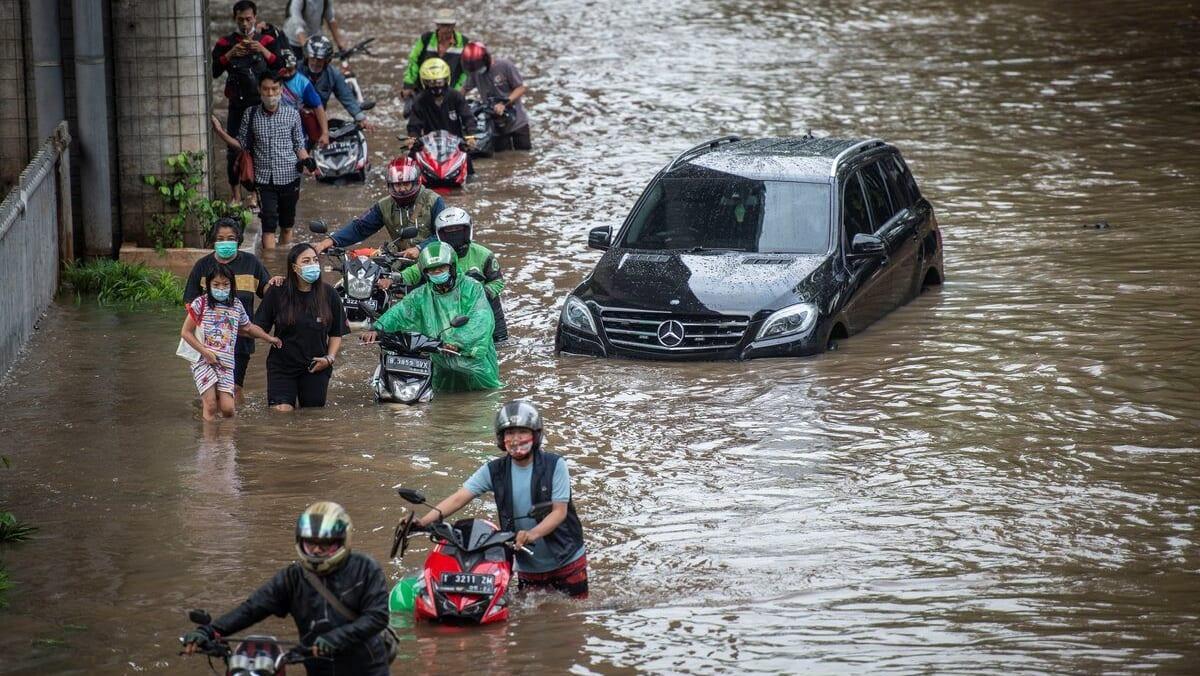
At first, it sounded like a routine precaution. But my partner explained that during the rainy season, intense downpours can leave roads covered in water when drainage systems cannot keep up.
It made me think about something I had not seriously considered before: a building might look perfectly suitable on a sunny day, yet become difficult to reach after heavy rain.
In Jakarta, flood risk is not simply a question of bad weather. It is part of how people choose where to live, work, shop, and travel.
Why Can Rainfall Overwhelm the Streets?
Indonesia’s rainy season does not arrive everywhere at the same time. Rainfall patterns differ across its many islands and regions.
In Jakarta, heavy tropical downpours can deliver large amounts of rain within a short period.
When rainwater reaches streets faster than drains and canals can carry it away, temporary flooding can develop.
But drainage capacity is only one part of the problem.
According to Indonesia’s National Research and Innovation Agency (BRIN), Jakarta’s flooding is driven by several connected factors, including extreme rainfall, land subsidence, and waterways obstructed by sediment and waste.
In other words, a storm does not need to be the only problem. The condition of the city matters just as much.
A City Built on Low Ground
Jakarta has a geographical disadvantage.
The city’s disaster management agency reports that approximately 40% of its territory consists of low-lying land below average sea level. Thirteen rivers also pass through Jakarta before reaching Jakarta Bay.
Rainfall upstream can therefore contribute to flooding downstream, even when the heaviest rain falls outside the city.
In northern coastal areas, high tides can make it harder for water to drain toward the sea.
Then there is land subsidence.
Parts of Jakarta are gradually sinking, with excessive groundwater extraction among the contributing causes. This increases flood exposure and can make drainage systems less effective.
Meanwhile, roads, buildings, and paved surfaces have replaced areas where rainwater could once soak into the ground.
The result is a city where heavy rain, overflowing rivers, coastal conditions, and urban development can combine to create serious flooding.

Why Flood History Matters When Renting a Shop
This explains why my local partner’s advice was so practical.
For a business, flooding does not have to enter the shop itself to cause damage.
If the surrounding road is submerged, customers may not be able to reach the entrance. Deliveries can be delayed, staff may struggle to get to work, and electricity or equipment may be affected.
A ground-floor shop, basement, or underground parking area may face different risks from an upper-floor office.
Before renting a property, it makes sense to ask whether the building or access roads have flooded before, how deep the water became, and how long it took to recede.
Jakarta provides public flood-information services, including historical flood data and flood-risk maps. These are useful starting points, although they cannot guarantee that a particular building will remain safe.
Talking to nearby shopkeepers and visiting the location after heavy rain may reveal details that are difficult to notice during a normal property inspection.
Is the Next Rainy Season Going to Be Different?
In October 2026, Indonesia’s Meteorology, Climatology, and Geophysics Agency (BMKG) forecast a later-than-usual start to the 2026–2027 rainy season across much of the country, influenced by a strong El Niño.
The agency also emphasized that rainfall conditions would vary by region.
A delayed rainy season does not eliminate the possibility of dangerous local storms.
For residents, the more useful question may be not simply when the rain begins, but how well their neighborhood can handle it.
Learning to See a City Differently
I used to think of a good commercial location mainly in terms of accessibility, visibility, and the surrounding neighborhood.
My partner’s advice added another question: what happens to this street when it rains?
That question applies far beyond business.
It matters to parents taking children to school, delivery riders trying to complete an order, workers commuting home, and families living in low-lying neighborhoods.
Jakarta’s flooding problem cannot be solved by a single bigger drain. It requires better water management, functioning waterways, responsible urban planning, and attention to the city’s sinking ground.
Sometimes, understanding a city means looking beyond how its streets appear on a sunny day—and asking what happens when the rain arrives.