
Indonesia and South Korea – Two Very Different Demographic Futures
Indonesia and South Korea are both major Asian economies, but their populations are moving in very different directions.
One remains relatively young and is still growing.
The other has entered one of the fastest demographic ageing processes in the world.
The contrast becomes clear when looking at age, fertility, life expectancy, and the structure of each population.
A 15-Year Gap in Median Age
In 2025, Indonesia’s median age was about 31.4 years.
South Korea’s median age was about 46.7 years.
That is a gap of more than 15 years.
Median age means that half of the population is younger than that age and half is older.
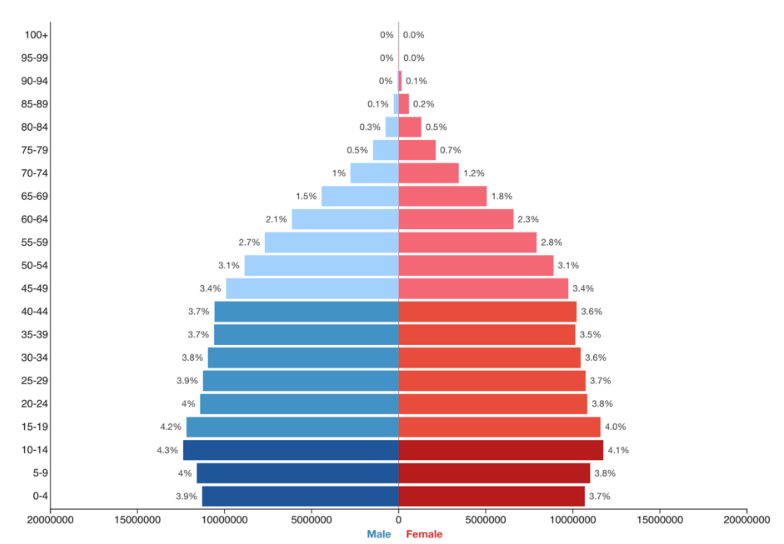
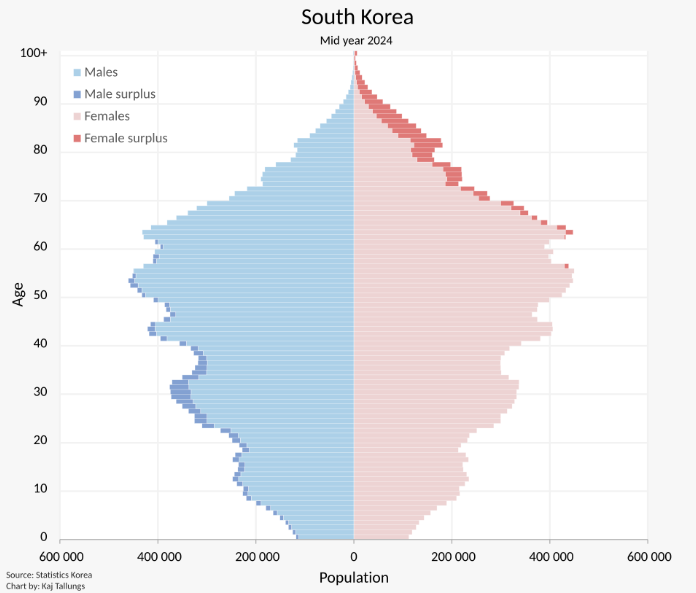
The difference is significant because age structure affects almost every part of society — from the labor market and consumer spending to housing, healthcare, education, and pensions. UN population data show a much younger age structure in Indonesia, while South Korea’s population pyramid has become increasingly narrow at the younger ages.
South Korea Has Already Become a Super-Aged Society
In 2025, people aged 65 and older accounted for about 20.3% of South Korea’s population.
South Korea has therefore crossed the commonly used 20% threshold for a “super-aged society.”
The share is expected to keep rising. Statistics Korea projects that people aged 65 and older could account for more than 30% of the population by the mid-2030s and more than 40% around 2050.
This demographic shift is already affecting healthcare costs, pensions, employment, housing, and regional population decline.
Indonesia Is Younger — But Ageing Has Started
Indonesia is still much younger than South Korea, but it is not immune to ageing.
Indonesia’s 2025 Intercensal Population Survey found that people aged 60 and older accounted for 11.97% of the population.
Indonesia’s statistics agency now describes the country as having entered the ageing-population phase.
The difference is therefore not that Indonesia is young while South Korea is old.
The more accurate description is that the two countries are at very different stages of the same demographic transition.
South Korea is already deep into population ageing.
Indonesia is entering the earlier stages.
Fertility Shows the Largest Difference
Birth rates show an even sharper contrast.
Indonesia’s total fertility rate in 2025 was 2.13 children per woman, close to the replacement level needed for a population to reproduce itself over the long term.
South Korea’s total fertility rate was 0.799 in 2025.
Although this was an improvement from 0.748 in 2024, it remains one of the lowest fertility rates in the world.
This difference has major long-term consequences.
Indonesia continues to have a relatively broad base of children, young adults, and working-age people.
South Korea has fewer young people entering each generation, while the number of older people continues to increase.
Life Expectancy Moves in the Opposite Direction
South Korea’s population is much older, but people also live significantly longer.
According to official Korean statistics, life expectancy at birth was 83.7 years in 2024.
World Bank data place Indonesia’s life expectancy at about 71 years in 2024.
That creates a difference of roughly 12 years.
The gap reflects differences in healthcare access, income, nutrition, infrastructure, public health, and other social conditions.
It also means the two countries face different policy challenges.
Indonesia still has significant room to improve longevity and health outcomes.
South Korea must support a rapidly growing elderly population living longer than previous generations.
One Population Is Still Growing
Indonesia’s population reached about 285.7 million in 2025 and was still growing at approximately 0.8% annually, according to World Bank data.
South Korea’s population was about 51.7 million, with population growth at approximately -0.1% in 2025.
This difference affects the two economies in very different ways.
Indonesia still has a large and expanding domestic market supported by younger consumers and a growing workforce.
South Korea must increasingly deal with labor shortages, shrinking school-age populations, regional decline, and a rising old-age dependency burden.
Two Countries at Different Points in the Same Transition
The demographic contrast between Indonesia and South Korea is striking.
Indonesia still has many of the characteristics of a relatively young population:
- a median age in the early 30s
- fertility close to replacement level
- continuing population growth
- a large working-age population
South Korea shows the opposite pattern:
- a median age approaching the late 40s
- very low fertility
- population stagnation or decline
- a rapidly growing elderly population
However, Indonesia’s demographic advantage should not be viewed as permanent.
Its fertility rate has fallen over time, its elderly population is increasing, and population growth is gradually slowing.
The main difference is timing.
Indonesia is entering demographic ageing from a much younger starting point, while South Korea is already experiencing the social and economic consequences at an advanced stage.
Key Points
- Median age: Indonesia about 31.4 years / South Korea about 46.7 years in 2025.
- Fertility rate: Indonesia 2.13 / South Korea 0.799 in 2025.
- Life expectancy: Indonesia about 71 years / South Korea 83.7 years in 2024.
- Older population: Indonesia’s population aged 60+ reached 11.97%, while South Korea’s population aged 65+ reached about 20.3%. The age thresholds differ, so these figures should not be treated as a direct like-for-like comparison.
- Population growth: Indonesia is still growing, while South Korea has moved into population stagnation and decline.
- Overall pattern: Indonesia remains substantially younger, but both countries are moving toward older population structures at very different speeds.