
Indonesia Since 1900 – From Colonial Rule to a Modern Republic
At the beginning of the 20th century, the country now known as Indonesia did not yet exist as an independent republic.
Most of the archipelago was governed as the Dutch East Indies, a colonial territory administered from Batavia, today’s Jakarta. By around 1900, Dutch control had expanded across much of the archipelago, while the colonial state was becoming more centralized and bureaucratic.
The next century would bring colonial reform, nationalism, Japanese occupation, revolution, authoritarian rule, economic transformation and democratization.
Understanding this sequence helps explain many features of modern Indonesia.
1900s: The Dutch East Indies and the Ethical Policy
In 1901, the Dutch government formally introduced what became known as the Ethical Policy.
It was presented as an effort to improve education, irrigation, infrastructure, health and welfare in the colony. It also expanded administrative institutions and created limited representative bodies, including the Volksraad, or People’s Council, in 1918.
The policy did not end colonial rule or political inequality. But increased access to education and new organizations contributed to the emergence of a modern Indonesian political consciousness.
One early organization was Budi Utomo, founded in 1908. It was followed by other movements, including Sarekat Islam, which became a much larger political organization.
These organizations did not all share the same ideology or strategy, but together they helped create a new political idea: that the many islands and peoples of the Dutch East Indies could belong to a single nation.

Nationalism Begins to Take Shape
During the early decades of the 20th century, nationalism became increasingly organized.
Students, intellectuals, Islamic organizations, labor groups and political activists began discussing independence, national identity and self-government.
This process gradually transformed the idea of “Indonesia” from a geographical term into a political and national identity.
By the 1920s and 1930s, nationalist leaders including Sukarno had become increasingly prominent, while the colonial government responded to some movements with arrests, restrictions and exile.
The central question was becoming clearer:
Would the archipelago remain a Dutch colony, or become an independent state?
1942–1945: Japanese Occupation
That question changed dramatically during the Second World War.
Japan invaded the Dutch East Indies in 1942, bringing Dutch colonial administration to an abrupt end.
The Japanese occupation was harsh and caused severe economic and social hardship. At the same time, the collapse of Dutch authority created a new political environment in which Indonesian nationalist leaders gained greater organizational experience and visibility.
When Japan surrendered in August 1945, the political situation changed almost overnight.
17 August 1945: The Proclamation of Independence
On 17 August 1945, Sukarno and Mohammad Hatta proclaimed Indonesia’s independence in Jakarta.
The proclamation was short, but its meaning was enormous.
Indonesia had declared itself an independent republic.
Sukarno became the country’s first president and Mohammad Hatta its first vice president.
But independence in 1945 did not immediately end the conflict.
The Netherlands attempted to restore control over the former colony, leading to several years of armed conflict and diplomatic negotiations.

1945–1949: Revolution and the Struggle for Sovereignty
The period between 1945 and 1949 is often described as the Indonesian National Revolution.
Indonesian forces and political leaders resisted the return of Dutch rule while negotiations took place under increasing international pressure.
The United Nations became involved, and negotiations eventually led to the Round Table Conference in The Hague in 1949.
On 27 December 1949, the Netherlands formally transferred sovereignty to the Republic of the United States of Indonesia.
During 1950, the federal structure was replaced by the unitary Republic of Indonesia.
Indonesia joined the United Nations on 28 September 1950 as its 60th member state.
The Sukarno Era
The new republic faced an enormous challenge.
Indonesia was not simply building a government. It was trying to unite thousands of islands, hundreds of ethnic groups, multiple religions and many regional political interests within one national system.
During the 1950s, Indonesia initially operated under a parliamentary political system.
Political instability, regional tensions and conflicts among political parties eventually contributed to President Sukarno’s shift toward what became known as Guided Democracy.
By the late 1950s and early 1960s, political power had become increasingly concentrated around the presidency.
Indonesia also developed a highly visible international role, particularly among newly independent countries emerging from colonial rule.
But political and economic tensions intensified during the 1960s.
1965–1967: A Major Political Turning Point
The mid-1960s marked one of the most dramatic transitions in modern Indonesian history.
Following political violence and an attempted coup in 1965, the Indonesian Communist Party was destroyed as a major political force. Large-scale killings and detentions followed across the country.
Estimates of the number killed vary widely, and this period remains one of the most difficult and contested chapters in Indonesian history.
In the following years, Sukarno gradually lost political power and General Suharto emerged as the dominant leader.
By 1967, Suharto had effectively replaced Sukarno.
1967–1998: The New Order
Suharto’s government became known as the New Order.
For more than three decades, Indonesia experienced highly centralized government, strong military influence and restricted political competition.
At the same time, the country underwent major economic development.
Infrastructure expanded, industrialization accelerated and poverty declined substantially over several decades.
The political system, however, remained tightly controlled.
Power was heavily concentrated in Jakarta, and political opposition, the press and civil society operated under significant restrictions.
This system remained in place until the Asian Financial Crisis reached Indonesia in 1997.
1997–1998: Crisis and the End of the Suharto Era
Indonesia was hit particularly hard by the Asian Financial Crisis.
The rupiah collapsed, the banking system came under severe pressure, companies failed and millions of households were affected.
The World Bank later estimated that Indonesia’s GDP contracted by about 13 percent in 1998.
Economic hardship combined with growing demands for political reform.
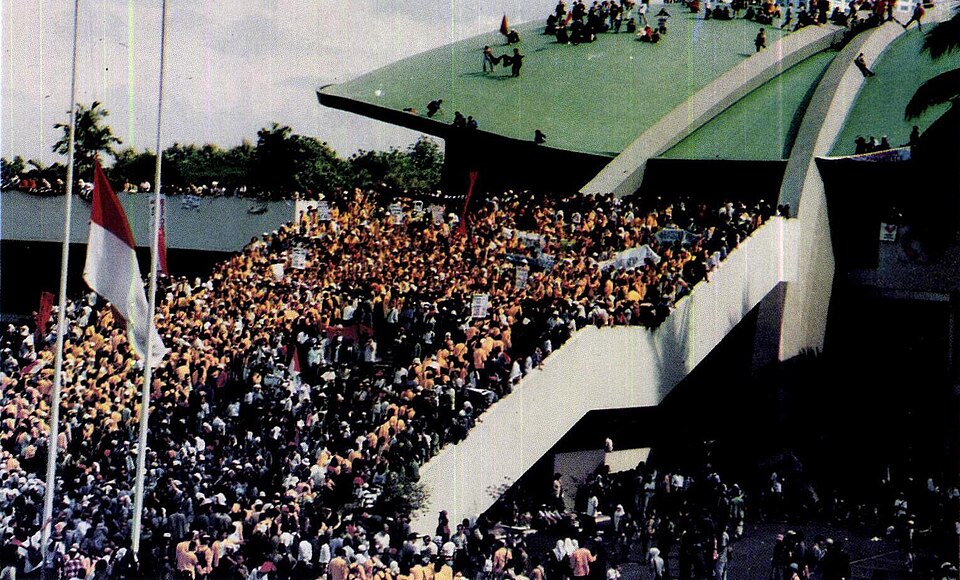
Student demonstrations expanded across the country, including a major occupation of the national parliament complex in Jakarta.
Suharto resigned in May 1998 after more than three decades in power.
His resignation marked the beginning of a new political period generally known as Reformasi.
Reformasi: Democracy and Decentralization
After 1998, Indonesia began one of the most significant political transformations in its modern history.
The constitution was amended, presidential power was reduced, legislative institutions were strengthened and elections became more competitive.
Indonesia also implemented one of the world’s largest decentralization programs.
Beginning in the early 2000s, substantial political, administrative and financial authority shifted from Jakarta to district and municipal governments.
In 2004, Indonesians directly elected their president for the first time.
The country that had spent most of the 20th century under colonial rule or centralized authoritarian government had entered a decentralized democratic era.
More Than a Century of Transformation
Indonesia’s path since 1900 can be divided into several major historical phases:
Colonial rule → Nationalism → Japanese occupation → Independence → Revolution → Sukarno → New Order → Reformasi
Each period left institutions, political traditions and social memories that continue to shape Indonesia today.
Modern Indonesia is therefore not simply the result of independence in 1945.
It is the result of more than a century of struggles over who should govern the archipelago, how power should be distributed and how enormous cultural and regional diversity could be maintained within a single republic.
Key Timeline
| Year | Event |
|---|---|
| 1901 | Dutch Ethical Policy begins |
| 1908 | Budi Utomo founded |
| 1942 | Japanese occupation begins |
| 17 Aug 1945 | Indonesia proclaims independence |
| 1945–1949 | Indonesian National Revolution |
| 27 Dec 1949 | Netherlands formally transfers sovereignty |
| 1950 | Indonesia becomes a unitary republic and joins the UN |
| Late 1950s | Sukarno establishes Guided Democracy |
| 1965–1967 | Major political transition from Sukarno to Suharto |
| 1967–1998 | Suharto’s New Order |
| 1997–1998 | Asian Financial Crisis |
| May 1998 | Suharto resigns; Reformasi begins |
| 2001 onward | Major decentralization takes effect |
| 2004 | First direct presidential election |
Key Points
- Indonesia entered the 20th century as the Dutch East Indies, not as an independent state.
- Early colonial-era education and political organizations contributed to the growth of Indonesian nationalism.
- Japanese occupation from 1942 to 1945 ended Dutch colonial administration and reshaped the political environment.
- Indonesia proclaimed independence on 17 August 1945, but sovereignty was formally transferred by the Netherlands only in 1949.
- The republic later experienced both Sukarno’s Guided Democracy and Suharto’s New Order.
- The fall of Suharto in 1998 began Reformasi, bringing constitutional reform, competitive elections and decentralization.
- Modern Indonesia is the result of a long transition from colony to centralized state and then to a decentralized democratic republic.